Air Commodore Marcus (Mickey) WITHEROW. Pictured as ADC to the AOC-in-C Transport Command (1967)
Air Commodore Marcus (Mickey) WITHEROW, born on 17 August 1936, died after a long illness on 1 February 2021 aged 84. He was conscripted as an Airframe Mechanic in the RAF at the No2 School of Recruit Training, RAF Cardington, on 21 April 1955 before continuing his specialist training at the No10 School of Technical Training at RAF Kirkham. During his training, he was rapidly identified as being ‘of officer material’ and encouraged to apply for a 6-year Short-Service Commission in the RAF Regiment. Entering officer training at the Officer Cadet Training Unit (OCTU) at RAF Jurby in March 1956, he graduated as a Pilot Officer on 21 June 1956 and was assigned immediately to the RAF Regiment Depot at RAF Catterick for his specialist Junior Regiment Officers’ Course (JROC).
Upon his JROC graduation that November, he was posted to the Aden Protectorate Levies – an Arab military force raised for the local defence of the Aden Protectorate under British rule and commanded at that time by the RAF Regiment – and to No66 (Field) Squadron RAF Regiment at RAF Khormaksar. He became the Squadron Adjutant in April 1957, was promoted to the rank of Flying Officer and was then detached for six months to RAF Muharraq in Bahrain on airbase defence duties before a transfer to No62 (Field) Squadron RAF Regiment ensued at RAF El Adem in Libya.
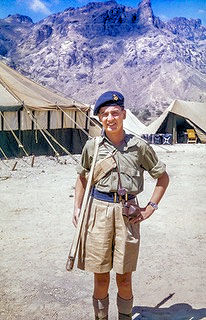
Air Commodore Marcus (Mickey) WITHEROW. Pictured as a junior officer
The Squadron became something of experts in long-range desert operations, tasked with lying up in the deep desert, waiting to attack the expected Egyptian incursion and their advance to Tobruk. That incursion never came, but he did take on a pioneering north-to-south Landrover crossing of the Sahara in 1958. Setting off from El Adem, he made it to southern Niger (roughly 1,500 miles) before being stopped by floods, just shy of their actual destination of Kano. When he returned home to Lockerbie on leave, he was amazed to see a local newspaper headline proclaiming, “Dumfries Man Crosses Sahara” and wondered at the coincidence; when he opened the paper he saw a photo of himself.
In April 1959, he was posted back to the UK and No15 (Field) Squadron at RAF Innsworth. He moved that November to join No48 (Field) Squadron at RAF Felixstowe, again as the Squadron Adjutant, from where he completed No136 Three-inch Mortar Course at the Army’s School of Infantry at Netheraven. From October 1960, he served as a Flight Commander on No2 (Field) Squadron RAF Regiment at RAF Colerne, where he was promoted to the rank of Flight Lieutenant, until October 1962 when a posting to RAF Geilenkirchen in Germany as Officer Commanding Ground Defence Training Flight followed.
From Germany, he returned to England in July 1965 to the RAF Regiment Depot Catterick as an instructor on its Training Wing, where he stayed until selected as the Aide-de-Camp to the Air Officer Commanding-in-Chief RAF Transport Command – Air Marshal Sir Kenneth ‘Bing’ Cross – in April 1966; he stayed in the ADC post when Air Marshal Sir Thomas Prickett assumed command in 1967. Clearly, he discharged his duties well as he subsequently assumed command, on promotion to the acting rank of Squadron Leader, of No26 (Light Anti-Aircraft) Squadron RAF Regiment at RAF Bicester on 3 June 1968, undertaking the L40/70 Bofors gun Familiarisation Course at the Royal School of Artillery, Larkhill, before gaining substantive rank on 1 January 1970. He returned once more to Training Wing at the RAF Regiment Depot Catterick in April 1970 before undertaking the RAF Personal Staff Course at RAF Bracknell from January to December 1971, whereupon he was posted to the staff of the Director of Security (RAF) and Commandant General RAF Regiment in the Ministry of Defence (Air Force Department) in London.
After a successful tour in the MOD, he moved – as an acting Wing Commander – in October 1974 to HQ Allied Air Forces Central Europe (AAFCE) at the USAF’s Ramstein Airbase in Germany, a NATO assignment in the Air Headquarters. His duties included providing specialist airbase force protection (known then as ‘Survive-to-Operate’ or ‘STO’) advice to the Commander – a 4-star USAF officer and Commander USAF Europe – and as Chief STO Evaluator on the NATO Tactical Evaluations of the participating Europe-based air forces. From Ramstein, he returned to the UK and to the RAF College Cranwell, where he undertook the RAF Air Warfare Course from July to December 1976. Upon completion of the course, he was posted back to the RAF Regiment Depot Catterick as Officer Commanding No3 Wing RAF Regiment, with three Squadrons, together with an Independent Tigercat Surface-to-Air Missile Flight, under command.
Following yet another successful command tour, he was posted once again – on promotion to acting Group Captain – to the staff of the Director of Security (RAF) and Commandant General RAF Regiment in the MOD in September 1978. In 1979, he was deputy to the Commandant General on the MOD team sent to Zambia – at the behest of Lord Carrington, the Secretary of State for Defence – prior to the Commonwealth Heads of Government (CHOG) Conference – which HM The Queen was secretly scheduled to attend. Their mission was to determine how to neutralise the Zimbabwe African People’s Union (ZAPU) and Zimbabwe African National Union (ZANU) guerrilla surface-to-air missile threat to civil flights – and particularly Her Majesty’s – to and from the capital, Lusaka. Within a day of the Team’s arrival, the problem was brought vividly to the fore when the Rhodesian SAS raided the guerrilla camps in the city; when the Zambian Air Force took to the air in response, they were engaged by the Zambian Army! The RAF Regiment-proposed solution satisfied the Defence Secretary, Foreign Office and the Prime Minister, Margaret Thatcher, and the Conference went ahead as planned without incident, paving the way for the successful Lancaster House Agreement some months later.
Promoted to substantive Group Captain in January 1980, he returned once more to Catterick in the April, this time as Commandant of the RAF Regiment Depot and, in June that year, became the first RAF Regiment officer to be appointed as Aide-de-Camp to HM The Queen. From his tour at Catterick, he attended the prestigious Royal College of Defence Studies Course – the first RAF Regiment officer to do so – from January to December 1983. In January 1984, he was posted to Headquarters RAF Germany as the Command Regiment Officer on the staff of the Commander-in-Chief, a post he held until September 1985 when, on promotion to the acting rank of Air Commodore, he became the Director of Personnel (Ground) at RAF Barnwood, where he controlled the careers of all ground branch and trades personnel for the RAF. He achieved substantive promotion in July 1986.
In July 1987, he moved, for the final time, back to the Commandant General’s staff in the MOD as Director RAF Regiment and Fire Services (RAF) until September 1990, when he prepared for his retirement from the Service – and his beloved Regiment – in November 1990.
Upon retirement from the RAF he went on to become the Director of Information Technology at Coutts Consulting, retiring for the final time in 2001. During his retirement, he remained an active participant in Corps matters and was always to be seen at the many RAF Regiment events and functions. To all who knew him, he was RAF Regiment to the core and epitomised the ethos and traditions of the Corps. He is survived by his wife, Mary and sons Rupert and Dominic, to whom the Corps extends its sincerest condolences.
[MRH]